

By Leonardo Cantoni, founder of Rileva · Published 9 October 2026 · Perplexity details checked 9 October 2026
Key takeaways
- Perplexity's Model Council runs one question across several models and writes a synthesis of where they agree and differ. Which plans include it has changed during 2026, so check before you pay.
- The alternatives differ in three ways: who picks the models, who does the comparing, and how you pay.
- Rileva's Council asks 3 models from 3 different labs at once and writes one summary; side-by-side apps leave the comparing to you; Karpathy's llm-council is free code you run yourself; and the by-hand method costs nothing but time.
- Yes, Rileva is our product. Where Perplexity is the better choice, we say so.
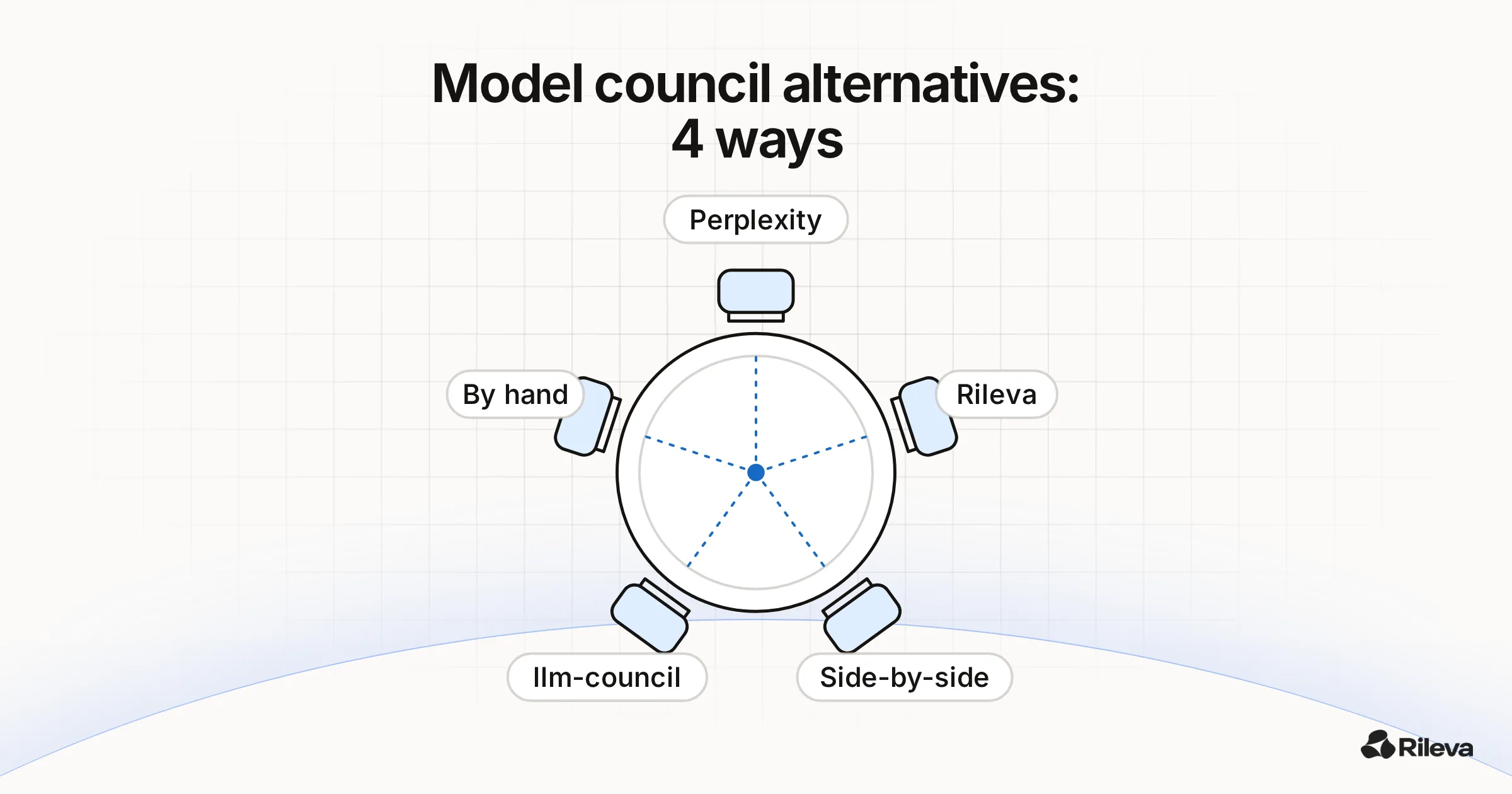
Asking one AI a hard question gets you one confident answer. Asking several, and seeing where they part ways, tells you which parts of the answer are solid and which depend on assumptions. That's why "model council" features took off this year. Perplexity has the most talked-about one. It isn't the only way to do it, and depending on how you work, it may not be the one that fits.
What Perplexity Model Council is (as of October 2026)
From Perplexity's own pages, as we checked them on 9 October 2026:
- Launched 5 February 2026. Your query "runs across three of the models available on Perplexity at once", and "a synthesizer model reviews the outputs, resolves conflicts where possible, and gives you one answer that shows where the models agree and where they differ" (Perplexity blog).
- Added to Perplexity Computer in March for Max subscribers (changelog, 5 March 2026).
- Expanded to Computer on 28 July 2026. In Computer you pick the lineup yourself, "two to eight models from OpenAI, Gemini, Anthropic, and open source providers", plus the analysis depth, and the synthesis can be turned into reports or decks (Perplexity blog).
- Who gets it today depends on where you use it. Perplexity's help centre says: "On web and in the iOS app, Model Council is included for subscribers on the Max and Enterprise Max plans. It is not available on the Free, Pro, Education Pro, or Enterprise Pro plans." In Computer, it "is available in all paid plans", Pro included (help centre, 4 September 2026). On web, "A council on web always runs three models"; the two-to-eight choice is a Computer feature.
- Price and limits. Max is $200 a month (or $2,000 a year). Perplexity's Pro page shows $17 a month billed annually (perplexity.ai/pro). On web there's a monthly cap on Model Council queries. In Computer it uses credits: Pro gets 4,000 one-time bonus credits, and Max gets 35,000 bonus credits plus 10,000 a month (help centre: how credits work).
Where Perplexity is strong: in Computer you choose up to eight models, it sits inside a search product built around live web sources, and it can turn the result into documents. If that's what you need, it's a serious option.
Why people look for alternatives: they don't want a Perplexity subscription just for this, they don't want to budget usage credits. Some just want something simpler: one question, one comparison, no setup.
The 3 questions that decide which council fits you
Before comparing products, answer these for yourself:
- Who should pick the models? You (more control, more decisions), or the tool (less to think about, less control)?
- Who should do the comparing? A model that writes one summary, or you, reading the answers side by side?
- How do you want to pay? A flat subscription, usage credits, your own API keys, or nothing but your time?
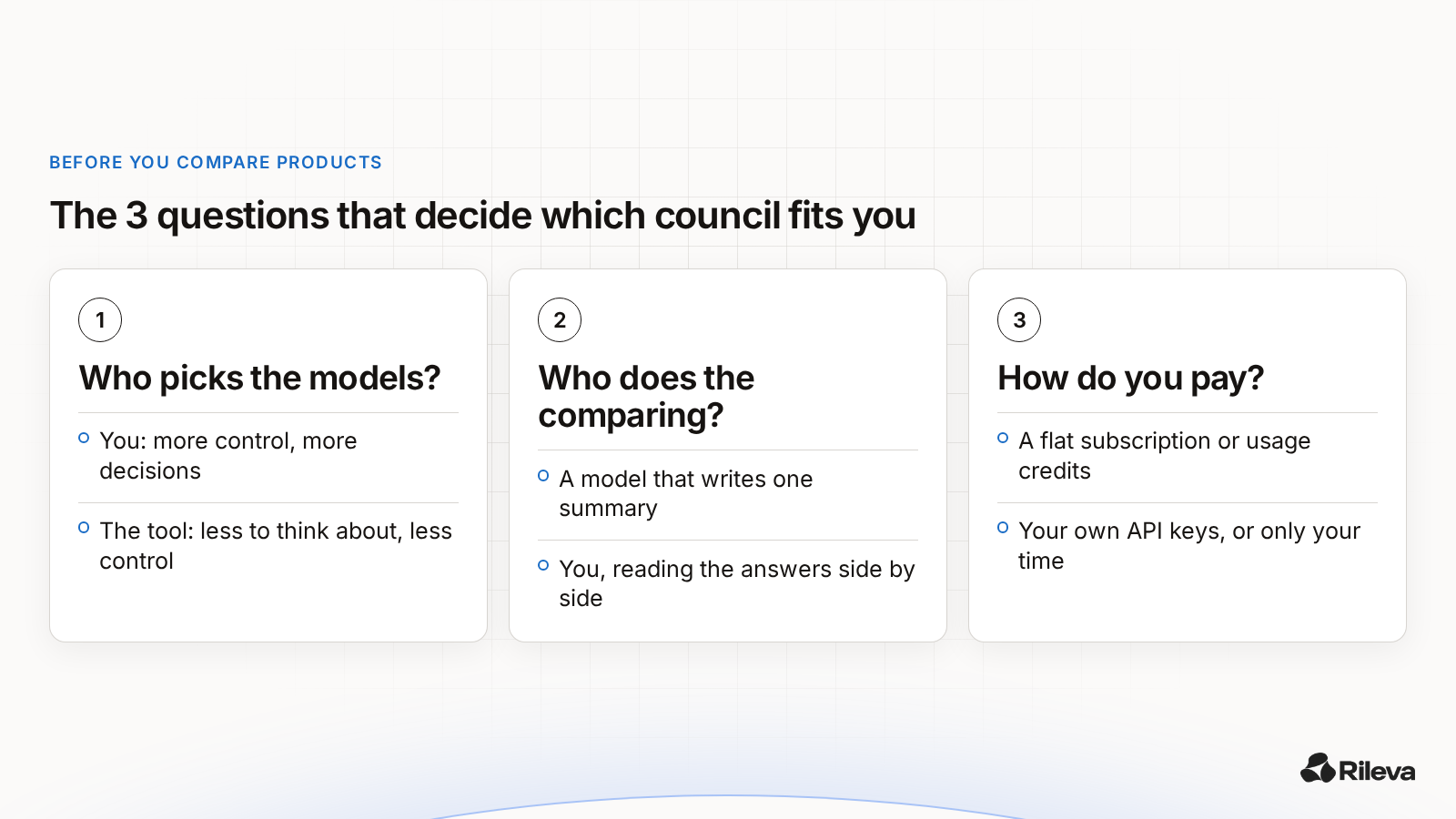
Keep your answers in mind. Each alternative below answers them differently.
Alternative 1: Rileva Council
Rileva is a chat workspace with models from several labs. Council is its main feature. Here's exactly how it works:
- It asks 3 models from 3 different labs at once, from a set lineup for that type of question. Rileva sorts your message into a type (coding, writing, research, planning and so on) and each type has a fixed lineup. The same type of question gets the same 3 models until a model is added, hidden or disabled.
- Each one answers on its own. They get the same question and context and are never told the others exist.
- One model groups the answers blind. It sees them only as A, B and C, so it doesn't know which model wrote which.
- Another model writes the summary, in four parts: the short answer, where they agree, where they differ and why, and what it depends on. Today that writer is GPT-6 Astra. In the default lineups it's also one of the 3 models that answered; it isn't told which answer is its own. Real model names are added back afterwards.
- You can read every full answer, side by side on desktop or in tabs on mobile.
- Custom Council lets you pick the 3 labs yourself from OpenAI, Claude, Gemini, Grok and Mistral; Rileva then picks the model within each lab.
- If one model fails, it isn't replaced. The Council runs with the 2 that answered; with fewer than 2 it fails.
Pricing: you can try it without an account (2 free answers), then get 40 free credits on signup, no card. Plus is €18 a month. A Council answer uses more of your monthly credits than a single-model answer.
Where Perplexity is the better fit:
- You want more than 3 models, or full control over the exact models: in Computer, Perplexity lets you choose 2 to 8.
- Live sources are the point. Perplexity is a search product first, so if you want every council answer built on fresh web results, start there.
- You want reports or slide decks generated from the result.
- You want a mature product. Rileva is young, with a small team.
Where Rileva may fit better:
- You want one flat plan (monthly, quarterly or yearly) with no API keys, and models from OpenAI, Claude, Gemini, Grok and Mistral in it.
- You want to ask without setting anything up: no lineup to choose, no depth setting.
- You care about the blind grouping step and want to read every full answer next to the summary.
- You want to try it before creating an account.
Want to see the four-part summary on your own question? Try Council free: 2 answers, no signup, one tap to Council.
Alternative 2: side-by-side chat apps
Apps like ChatHub, Poe (by @-mentioning several bots) and TypingMind's multi-model chats send one prompt to several models and show the answers next to each other. ChatHub shows up to six at once and has an experimental one-click "Summarize Chat". These details are as we checked them on 5 October 2026. We compared them in detail in our Poe alternative comparison, with prices checked on each company's site.
Choose this if you'd rather read every answer yourself and don't need a written comparison. The catch: with three to six long answers, the comparing is your job, and that's the slow part.
Alternative 3: Karpathy's llm-council (self-hosted)
Andrej Karpathy's llm-council is a small open-source web app. It sends your query to several models through OpenRouter, has them review each other's answers anonymously, and has a "Chairman" model write the final response. You need an OpenRouter API key and you pay per use. The README describes it as a fun Saturday hack he doesn't plan to support.
Choose this if you code, want full control, and are happy to maintain it. The catch: it's a starting point, not a product.
Alternative 4: do it by hand (free)
You don't need any product. The method takes three fresh chats in different labs' free apps, plus a fourth chat to compare. We wrote it up step by step in our LLM council guide. The short version:
- Write one brief with your question, your options, your constraints, and what success looks like.
- Paste it into three different labs' apps, each in a fresh chat.
- Paste the three answers into a fourth chat, labelled only A, B and C, with this prompt:
Here are three independent answers to the same question, labelled A, B and C.
1. The short answer: your own recommendation in two sentences.
2. Where they agree, stated once.
3. Where they differ, and why (the assumption or priority behind each view).
4. What it depends on: the facts about my situation that decide between them.
Don't side with a view just because more answers hold it. Flag any risk only one of them raised.
Choose this if you need a council a few times a month and don't mind 15 minutes of copy-paste.
Side-by-side summary
| Perplexity Model Council | Rileva Council | Side-by-side apps | Karpathy llm-council | By hand | |
|---|---|---|---|---|---|
| Who picks the models | 3 on web; you pick 2 to 8 in Computer | Set lineup per question type, or you pick 3 labs (Custom) | You | You (config) | You |
| Who compares | Synthesizer model | One model groups blind, another writes the summary | You (ChatHub has an experimental summary) | Peer review + "Chairman" model | You, or a 4th chat |
| See every full answer | Check in the app | Yes | Yes | Yes | Yes |
| How you pay | Max plan on web; any paid plan + credits in Computer | €18/month Plus (free to try) | App subscription | Your OpenRouter usage | Free tiers |
| Setup | None on web; pick models and depth in Computer | None | Pick models | Install and API key | Tabs |
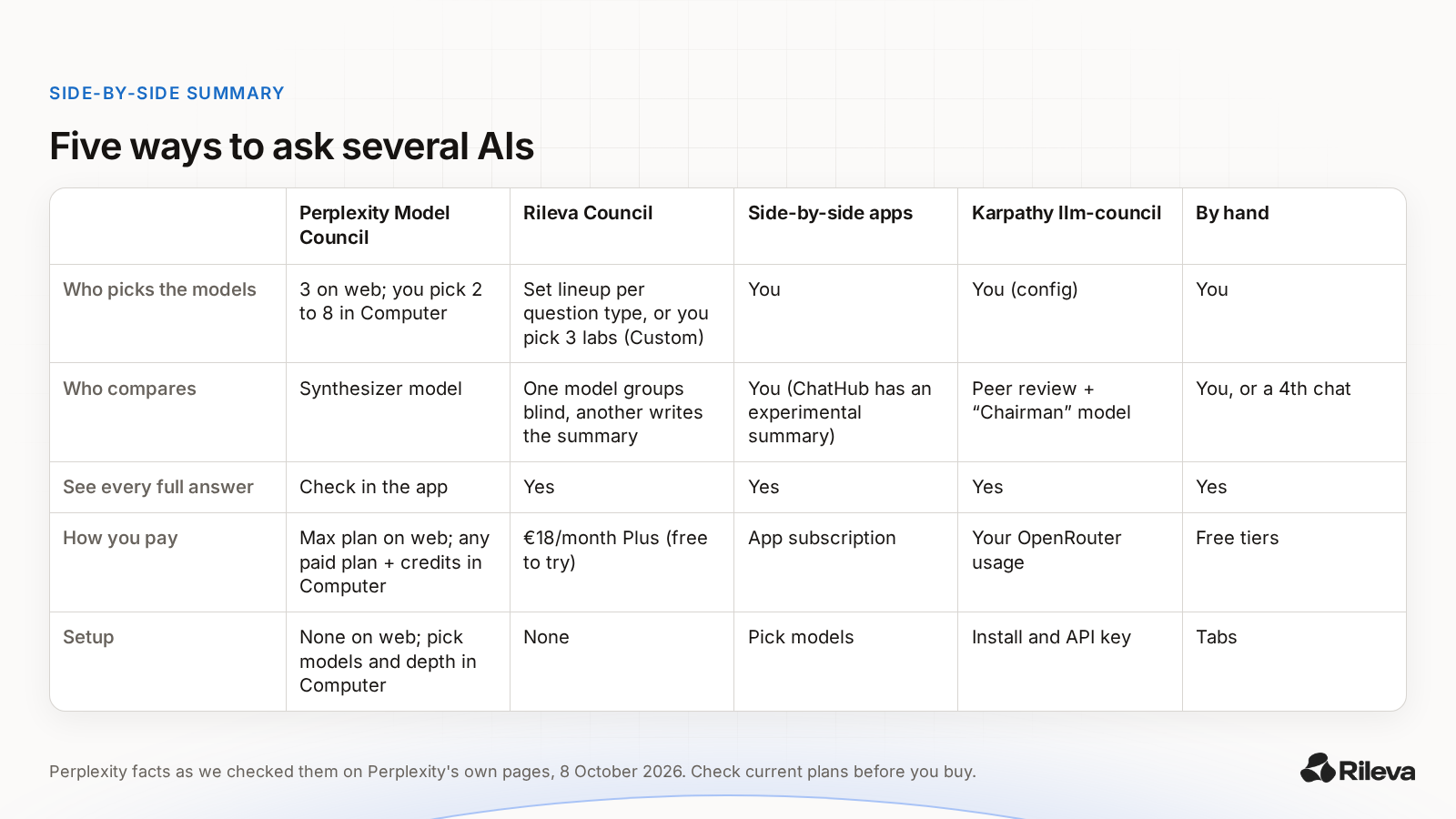
Perplexity facts as we checked them on Perplexity's own pages, 9 October 2026; other apps' details as in our Poe comparison. Check current plans before you buy.
How to get a useful answer from any council
Whatever you pick, the question matters more than the tool. Three habits make council answers far more useful:
- Give real context. "Should I raise prices?" gets three generic answers. "We're a 2-person SaaS at €9/month, 40% of users are on annual plans, churn is low, and we're considering €15" gets three answers you can act on.
- Make them commit. Ask for a clear recommendation, what it rests on, and what would change their mind. Hedged answers are hard to compare.
- Read "where they differ" first. Agreement feels reassuring, but the disagreement is usually where the useful information is: an assumption you hadn't made explicit, or a risk only one model raised.
A copy-paste version:
I need a second opinion before I decide.
DECISION: [one sentence]
OPTIONS: [A] / [B] / [wait]
WHAT I KNOW: [facts, and where they come from]
WHAT I'M ASSUMING: [assumptions]
HARD LIMITS: [budget, time, anything non-negotiable]

Give me a clear recommendation, the assumptions it rests on,
and the specific conditions under which it would be wrong.
What a Council answer looks like
We ran one real pricing question through Rileva's Council. It's a single run, shown as it came out, so it shows the format, not a promise of what you'll get.
We're a 2-person SaaS selling a scheduling tool to small clinics at €9 a month. About 300 paying customers, low churn, and most signed up more than a year ago. We're thinking of raising the price to €15 for new customers only, or for everyone with 60 days' notice. Which should we do? Give a clear recommendation, what it rests on, and what would change your mind.
Lineup in this run (8 Oct 2026): A: GPT-6 Astra · B: Claude Sonnet 5.5 · C: Grok 4.7, left to right as shown. Your run may differ.
All three gave the same recommendation, in their own words:
- A: "Raise the price to €15 for everyone, giving existing customers 60 days’ notice."
- B: "Raise the price for everyone to €15 with notice, but launch the new price for new customers first and send the existing-customer notice a few weeks later."
- C: "Raise the price to €15 for everyone, with 60 days’ notice. Do not grandfather the current base."
What they worked out the same way. Each one did the arithmetic: €2,700 a month today, €4,500 at €15, and revenue only drops below today's if about 40% of customers leave. A was careful to add that this is "a mathematical boundary, not an acceptable churn target." Each also flagged, in its own way, that low churn at €9 is not proof of loyalty at €15. A: low churn and long tenure "don’t prove customers will accept a 67% price increase". B: "Low churn today may reflect inertia, not loyalty."
Where they differed. Not on the direction, but on how fast to move and what counts as failure:
- A checks first. Talk to "a small mix of active, light-use and support-heavy customers" before notifying anyone. Then reconsider if price-driven cancellations approach 10% of the existing base, which it calls "my judgement, not an industry benchmark."
- B stages it. Put €15 live for new signups and "watch conversion for 3–4 weeks", then email existing customers personally. It's the only one to name the workload: "With two people, a wave of replies and cancellations in one month is a real cost." Its pause point is "more than about 10–15% cancellations" from the first batch of notices.
- C moves now. "Send the notice." Its line for calling the increase a mistake is much higher: "If a real sample (not a vibe) shows more than about 40% would leave, the increase destroys value."
That last gap matters most. A and B would pause at around 10–15% of customers leaving. C's line is about 40%, which is the point where revenue breaks even. Same recommendation, very different tolerance for losing clinics. That's a choice only you can make, and an agreement-only answer would have hidden it.
What the summary said. The summary is written by a model, not by us. In this run that was GPT-6 Astra, which was also seat A; it isn't told which answer is its own.
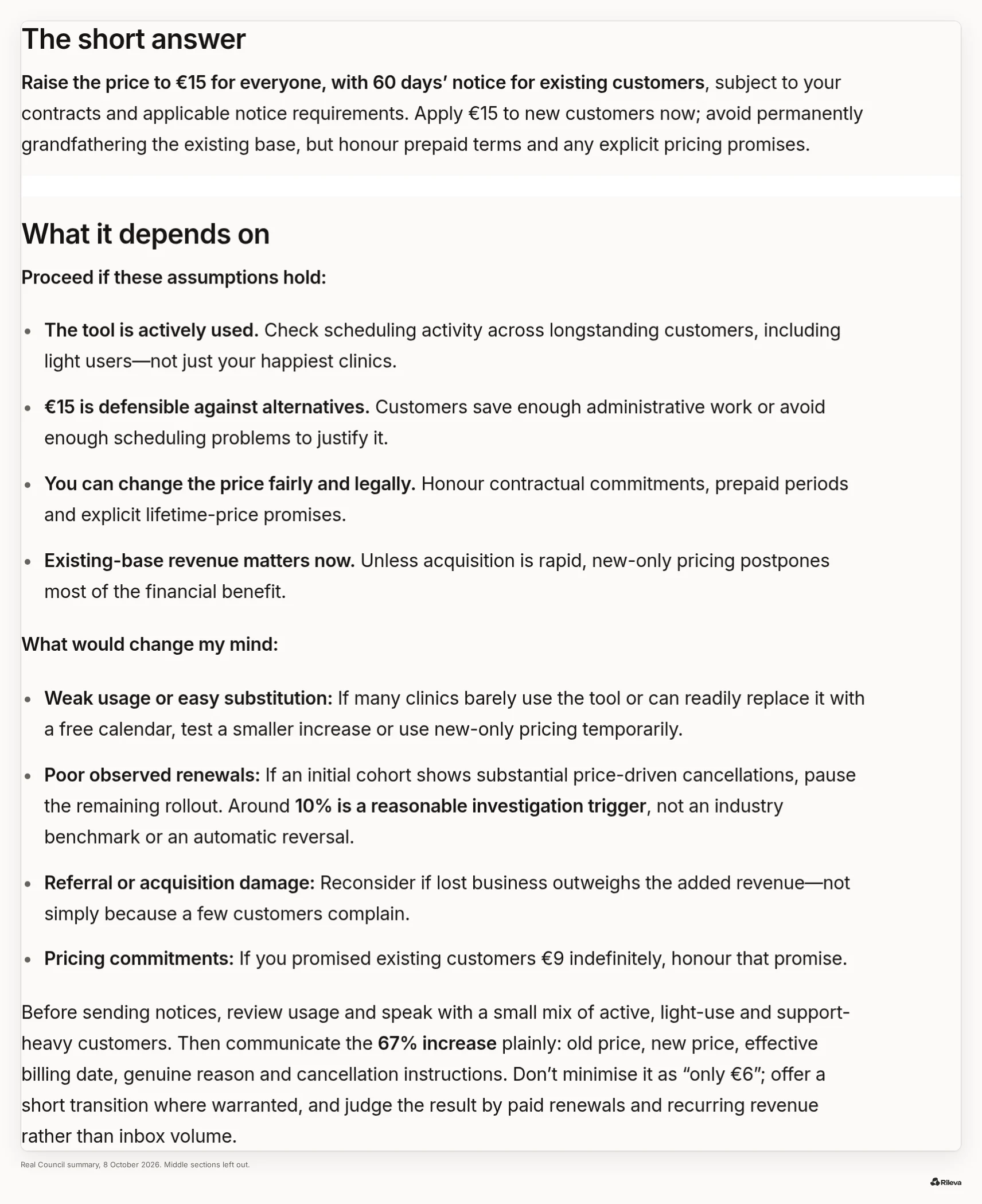
- The short answer: "Raise the price to €15 for everyone, with 60 days’ notice for existing customers, subject to your contracts and applicable notice requirements. Apply €15 to new customers now; avoid permanently grandfathering the existing base, but honour prepaid terms and any explicit pricing promises."
- Where they agree: all three recommend "moving the existing base to €15 rather than limiting the increase to new customers." It also pointed out the shared assumptions: that low churn reflects real value, and that you haven't promised anyone €9 for good. "Neither assumption is established by low churn alone."
- Where they differ: "The disagreement is about confidence and rollout—not the ultimate pricing direction." It labelled the three approaches "validate reliance and monitor renewals" ([A]), "stage the change" ([B]) and "move decisively without grandfathering" ([C]).
- What it depends on: whether the tool is actively used, whether €15 holds up against alternatives, whether your contracts allow the change, and whether revenue from existing customers matters now. It ends with practical advice: state the old price, new price, billing date, reason and how to cancel, and "judge the result by paid renewals and recurring revenue rather than inbox volume."
The summary also took sides on two points. It leaned toward A's lower pause point over C's: losing many clinics "could damage referrals and future growth even if immediate revenue rises." And B and C had compared your revenue per person with SaaS averages to argue you're underpriced; the summary leaned toward setting that aside, because "low revenue can reflect company scale, not necessarily a wrong price." Those are the summary writer's views, not a ruling. All three full answers are there to check them against.
Under the summary, the app showed its agreement note: "All 3 models agree on the recommendation." That line comes from the app, not the summary writer. It says the three recommendations match, nothing more. You can read all three full answers in the app.
FAQ
What is Perplexity Model Council? It's a Perplexity feature that runs one question across several AI models and has a synthesizer model write one answer showing where they agree and where they differ. On web it runs three models and is included with Max and Enterprise Max. In Perplexity Computer, available on all paid plans, you can choose two to eight models and the analysis depth.
Is there a free alternative to Perplexity Model Council? Yes. You can run a council by hand: paste the same brief into three different AI apps in fresh chats, then ask a fourth chat to compare the answers labelled A, B and C. Karpathy's open-source llm-council is free code, but you pay for model usage through OpenRouter.
What's the difference between a model council and a side-by-side chat app? A side-by-side app shows you several answers and leaves the comparing to you. A council adds a final step where a model compares the answers and writes one summary of where they agree, where they differ and why.
Does a model council make AI answers correct? No. Models can share the same blind spots, so agreement means the answers are consistent, not that they're true. A council is most useful for showing assumptions and risks you'd otherwise miss. For facts, check sources.
Can I choose the models in Rileva's Council? By default, Rileva uses a set lineup of 3 models from 3 different labs for each type of question. With Custom Council you pick the 3 labs yourself from OpenAI, Claude, Gemini, Grok and Mistral, and Rileva picks the model within each.
Can I try Rileva's Council without signing up? Yes. Guests get 2 free answers, and Council is available to guests. After that, signing up gives you 40 free credits, no card needed.
Try a council on your own decision
Get a second opinion in one message Fill in the brackets with a real decision. Council asks 3 AI models from 3 different labs at once and shows where they agree, where they differ, and what it depends on. 2 free answers, no signup. Ask Council → The question opens in the composer and waits for you to press send. Signed in, Council is already on; as a guest, it's one tap to Council.
Leonardo Cantoni, founder of Rileva